

For Global Security Directors, coordinating a physical security upgrade across multiple international branches is rarely straightforward. Whether you are standardizing commercial access control sys-tems in Frankfurt, upgrading video surveillance for business intelligence in Singapore, or deploying unified enterprise security solutions spanning North America, Europe, and Asia-Pacific, the opera-tional hurdles can quickly multiply.

Fragmented vendor relationships, shifting regional regulatory frameworks, and mismatched local in-stallation standards often turn multi-country programs into logistically complex endeavors. This is where strategic global security consulting and end-to-end execution become essential. At Global Pop LLC, we manage complex global security projects in over 70 countries. In this guide, we explore why turnkey project management is the defining engine of success for international security deploy-ments.

The Complexity of Multi-Site Security Rollouts

Managing security across diverse geographic regions introduces unique friction points. When every office or regional hub relies on independent local contractors, organizations frequently encounter:

  • Inconsistent Technical Standards: Variations in wiring specifications, hardware compatibility, and firmware versions lead to vulnerable gaps in the enterprise network.
  • Compliance Disconnects: Failing to adhere to regional data privacy laws (such as GDPR in Europe or local data residency mandates) can result in severe financial and legal penalties.
  • Communication Bottlenecks: Dealing with dozens of disparate suppliers creates administrative bloat, making it difficult to maintain accountability or accurate milestone tracking.

To overcome these challenges, enterprises must move away from piecemeal subcontracting toward comprehensive turnkey security solutions backed by rigorous international security project man-agement.
Why Turnkey Project Management is the Key to Global Success

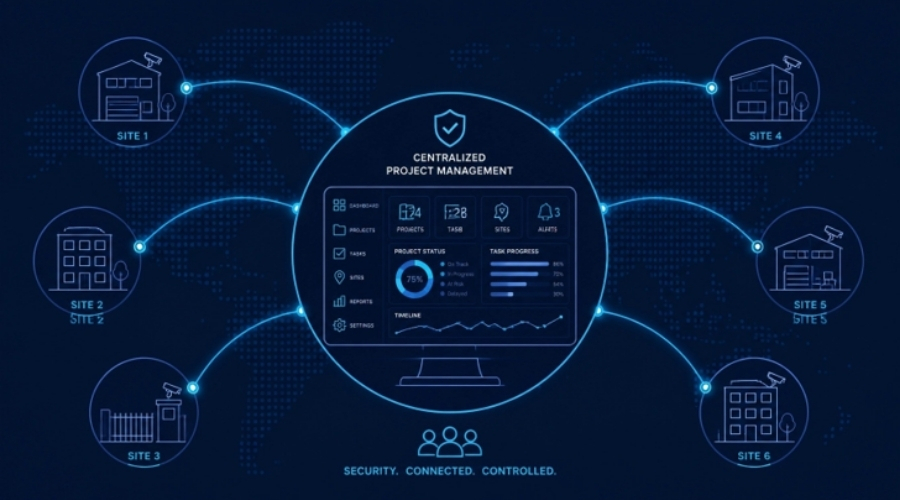
A turnkey approach means that a single specialized partner assumes full responsibility for the entire project lifecycle: from initial assessment and engineering design to procurement, installation, and on-going maintenance. For security leaders, this centralized model eliminates operational noise and de-livers several core advantages.

1.   A Single Point of Contact

Instead of juggling dozens of regional project managers, your Global Security Director coordinates directly with a dedicated account lead. This streamlines communication, accelerates decision-making, and ensures total transparency across all active sites.

2.   Streamlined Procurement and Logistics

International supply chains are notoriously volatile. A trusted integrator leverages vetted global logis-tics networks to source, clear customs, and deliver standardized hardware on schedule, eliminating costly customs delays and equipment shortages.

3.   Comprehensive Lifecycle Support

True global security systems integration goes far beyond mounting cameras and card readers. It encompasses structured security assessments, custom programming, rigorous testing and commis-sioning, user training, and ongoing lifecycle maintenance.

To explore how these capabilities align with your enterprise roadmap, visit our blog insights page for deeper case breakdowns.

—- IMAGEN PROYECTO LLAVE EN MANO —

Core Pillars of Effective Multi-Site Deployment

Executing a seamless rollout across dozens of countries requires a disciplined operational framework. Our methodology focuses on four foundational pillars:

Rigorous Security Assessment and Design

Before a single cable is laid, our engineers evaluate site-specific threat profiles, architectural blue-prints, and IT infrastructure. We design multi-site security solutions that harmonize global corpo-rate policies with local physical requirements.

Standardized System Integration Services

Consistency is the bedrock of enterprise security. By deploying standardized architectures for intru-sion detection, commercial access control systems, and high-definition video management, security teams gain centralized visibility and control over every regional asset.

On-Site Quality Control and Execution

Through our rigorously vetted worldwide partner network, we provide on-site supervision and quality control. Local technicians work under strict global guidelines, ensuring that every installation meets exact engineering specifications regardless of geography.

Global Security Standards Compliance

Navigating regional and international standards: from ISO guidelines to local building and privacy codes: requires deep regulatory expertise. Turnkey management ensures that all deployments achieve complete global security standards compliance from day one.

— IMAGEN GLOBAL SECURITY —

Best Practices for Global Security Directors

If your organization is preparing for an upcoming multi-country security upgrade, consider imple-menting these proven best practices:

  • Establish a Global Baseline First: Define standardized hardware and software blueprints before engaging regional stakeholders to ensure uniform protection across all sites.
  • Engage Integrators Early: Involve your security systems integration partner during the initial bud-geting and scoping phase to identify potential logistical roadblocks early.
  • Prioritize Centralized Management Dashboards: Ensure your access control and video surveil-lance platforms aggregate data into a unified pane of glass for enterprise-wide situational aware-
  • Plan for Long-Term Maintenance: Build ongoing support, spare parts management, and firmware update schedules into the initial project contract to protect your capital

Partnering for Global Resilience

Scaling security across international borders does not have to be an uphill battle. By pairing expert global security consulting with robust, turnkey project management, enterprises can achieve opera-tional excellence, strict compliance, and total peace of mind across 70+ countries.

At Global Pop LLC, our customer-centric philosophy is built on creating lasting partnerships that safe-guard your people, property, and data worldwide. Ready to streamline your next international securi-ty rollout? Contact our team today to discuss your organization’s unique requirements.

For Global Security Directors managing multi-country footprints, coordinating a physical security de-ployment across borders is one of the most formidable challenges in the enterprise landscape.

Whether you are standardizing commercial access control systems across twenty European capitals, deploying unified video surveillance for business intelligence in Latin America, or integrating high-stakes enterprise security solutions across Asia, the complexity multiplies exponentially with every new time zone.

Too often, organizations approach international security as a collection of isolated local projects. They contract separate vendors in each region, rely on fragmented communication channels, and hope that local teams will somehow align with overarching corporate policies. In practice, this decentralized approach leads to severe bottlenecks, budget overruns, compliance failures, and vulnerabilities that expose the enterprise to unacceptable risk.

The definitive differentiator between a chaotic, delayed rollout and a seamless enterprise security de-ployment is rigorous international security project management. At Global Pop LLC, we manage global security projects in over 70 countries. Through our experience, we have learned that world-class technology is only as effective as the project management framework binding it together.

The Hidden Costs of Fragmented Multi-Site Security Rollouts

When organizations attempt multi-country deployments without centralized project governance, they typically encounter a predictable cascade of failures:

  1. Inconsistent System Architecture: Different regions purchase disparate hardware and software, making centralized monitoring and consolidated management nearly impossible.
  2. Logistical Nightmares: Delays in customs clearance, unexpected import tariffs, and incompatible regional electrical standards stall deployment timelines by months.
  3. Regulatory Non-Compliance: Failing to adhere to regional data privacy mandates (such as GDPR in Europe or localized video retention laws) results in hefty fines and legal liabilities.
  4. Communication Silos: Without a single point of accountability, local contractors, internal IT teams, and executive stakeholders misalign on scope, budget, and milestones.

To overcome these hurdles, enterprises require comprehensive multi-site security solutions under-pinned by end-to-end turnkey security solutions and expert oversight.

Pillar 1: A Single Point of Contact for Absolute Clarity

The cornerstone of successful global rollouts is eliminating the friction of multi-vendor communica-tion. Managing dozens of disparate contractors across different continents drains internal leadership bandwidth.

By partnering with an experienced provider of global security consulting, enterprises gain a dedicat-ed Single Point of Contact (SPOC). Your SPOC acts as the central command hub, translating corporate security directives into actionable local execution plans while keeping executive stakeholders in-formed at every stage. This eliminates finger-pointing between regional installers and ensures that project velocity remains high, budgets remain intact, and accountability is absolute.

Pillar 2: Streamlined Procurement and Logistics Solutions

Equipping facilities across diverse international jurisdictions involves navigating a labyrinth of supply chain variables. Procurement delays can derail an entire enterprise roadmap.

A mature international project management framework integrates robust procurement and logistics solutions directly into the planning phase. This involves:

  • Global Sourcing & Standardization: Pre-vetted equipment lists that guarantee hardware consis-tency for commercial access control systems and IP cameras worldwide.
  • Staging and Customs Management: Anticipating regional import regulations, securing necessary certifications ahead of time, and pre-configuring devices to minimize on-site labor hours.
  • Inventory Control: Tracking shipments in real-time to ensure components arrive on site precisely when installation teams are ready.

Pillar 3: On-Site Project Management and Quality Control

Planning is vital, but flawless execution happens on the ground. Standardizing security systems inte-gration services across diverse physical environments requires vigilant oversight.

Global Pop LLC deploys expert on-site project managers who oversee local installation teams, con-duct rigorous testing and commissioning, and enforce strict quality control standards. Whether verify-ing camera field-of-view angles for video surveillance for business analytics or testing failover re-dundancies for access control servers, on-site supervision guarantees that every site meets your exact corporate benchmark before handoff.

Pillar 4: Guaranteeing Global Security Standards Compliance

Navigating international compliance is a high-stakes endeavor. Security requirements are rarely uni-form; regulations governing data residency, encryption standards, emergency egress, and biometric data collection vary drastically between countries.

Achieving global security standards compliance requires deep familiarity with both international frameworks and regional statutes. A structured project management approach ensures that every de-ployed system: from intrusion alarms to advanced enterprise security solutions: respects local laws without compromising your enterprise-wide security posture. Through meticulous audit trails, stan-dardized firmware management, and documented compliance reporting, your organization remains protected against both physical threats and regulatory penalties.

Leveraging Global Capability and a Trusted Partner Network

True global reach cannot be improvised. Achieving seamless global security systems integration across more than 70 countries demands an established ecosystem of vetted local expertise combined with centralized governance.

Our approach rests on three foundational strengths:

  • Global Capability: Proven execution in over 70 countries, bridging the gap between global enter-prise standards and local realities.
  • Trusted Partner Network: A rigorously vetted worldwide network of certified technicians and in-tegrators who understand local building codes, language nuances, and regional infrastructure.
  • Customer-Centric Philosophy: Building “Customers for Life” through transparent communication, scalable architecture, and comprehensive ongoing maintenance and support.

Managing physical security across a single corporate headquarters is complex enough. But when you are tasked with expanding enterprise security solutions across dozens: or hundreds: of facilities spanning multiple countries, the complexity multiplies exponentially. For Global Security Directors, or-chestrating a multi-country rollout involves navigating fragmented local supply chains, shifting regu-latory landscapes, diverse physical architectures, and a myriad of local contractors.

When things go wrong, the consequences extend far beyond budget overruns or schedule delays; they leave the enterprise vulnerable to security breaches and compliance penalties. At Global Pop LLC, we manage complex security initiatives in over 70 countries. Through our extensive experience, we have identified five of the most frequent missteps that derail multi-site deployments: and, more importantly, how expert international security project management solves them.

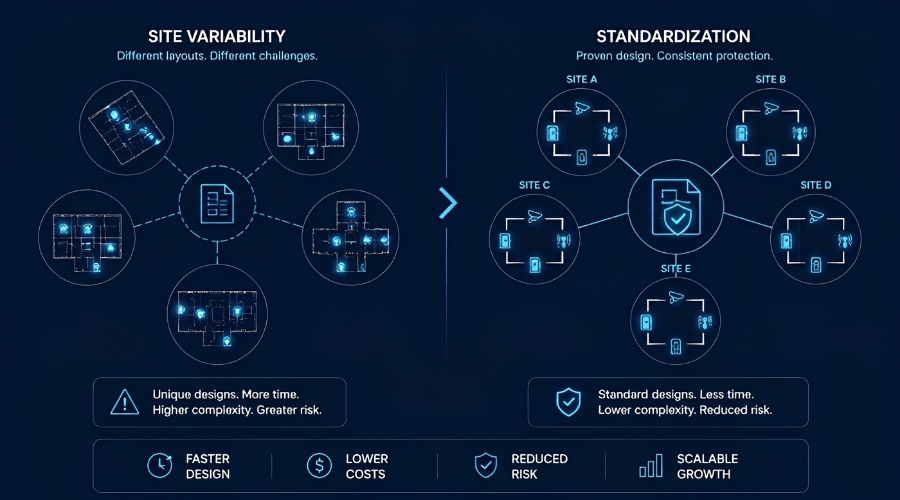
1.   Assuming All Sites Are Identical (Ignoring Site Variability)

One of the most tempting traps in a large-scale deployment is creating a single, rigid “cookie-cutter” security blueprint and assuming every branch, warehouse, or regional office will accommodate it seamlessly. In reality, site variability is the silent killer of rollouts.

Building age, existing cabling infrastructure, local network bandwidth, lighting conditions, architectur-al constraints, and local authority requirements vary wildly from one location to the next. When teams force uniform equipment stacks onto mismatched environments without prior site surveys, installa-tions stall immediately. Technicians encounter incompatible mounting surfaces, insufficient power over Ethernet (PoE) budgets, or conduits that cannot support new commercial access control sys-tems or high-resolution video surveillance for business networks.

The Global Expert Fix

True standardization does not mean ignoring local reality; it means defining a standardized perfor-mance baseline paired with rigorous pre-installation site assessments. Global experts deploy stan-dardized design templates that allow for pre-approved modular adaptations. By conducting struc-tured site readiness audits before shipping hardware, teams identify infrastructure gaps early, pre-venting costly mid-rollout redesigns.

1.   Overlooking Legacy Integration and Deferred System Testing

Another frequent pitfall occurs when organizations focus heavily on hardware delivery while treating system integration, network handshakes, and software licensing as an afterthought. Multi-site rollouts frequently stall not because cameras or card readers failed to arrive, but because legacy platforms do not communicate with the new head-end software.

Furthermore, delaying comprehensive testing until the physical installation is complete across all sites creates a massive bottleneck. If time synchronization is off across regional servers, event logging fails, forensic video retrieval becomes unreliable, and automated triggers between intrusion alarms and video management systems break down.

The Global Expert Fix

Integration must be tested and validated in a staged staging environment before field deployment. Enterprise-grade deployments require structured testing and commissioning protocols, ensuring that firmware versions, database schemas, and API integrations are fully validated prior to on-site imple-mentation.

2.   Overlooking Legacy Integration and Deferred System Testing

Another frequent pitfall occurs when organizations focus heavily on hardware delivery while treating system integration, network handshakes, and software licensing as an afterthought. Multi-site rollouts frequently stall not because cameras or card readers failed to arrive, but because legacy platforms do not communicate with the new head-end software.

Furthermore, delaying comprehensive testing until the physical installation is complete across all sites creates a massive bottleneck. If time synchronization is off across regional servers, event logging fails, forensic video retrieval becomes unreliable, and automated triggers between intrusion alarms and video management systems break down.

The Global Expert Fix

Integration must be tested and validated in a staged staging environment before field deployment. Enterprise-grade deployments require structured testing and commissioning protocols, ensuring that firmware versions, database schemas, and API integrations are fully validated prior to on-site imple-mentation.

3.   Underestimating Global Logistics and Supply Chain Friction


Shipping security hardware across international borders is fraught with regulatory hurdles. Import du-ties, customs clearance delays, restricted encryption regulations, and local certification requirements (such as CE marking in Europe or regional compliance certificates in APAC and Latin America) can trap vital equipment in customs warehouses for weeks.

When local supply chains are managed ad-hoc, stockouts at remote sites halt installation crews, lead-ing to idle labor costs and cascading schedule delays.

The Global Expert Fix

Successful execution relies on robust procurement and logistics solutions backed by a vetted, glob-al network of regional distribution hubs. Experienced security integrators leverage localized ware-housing and strategic pre-procurement so that equipment is staged regionally before installation teams arrive. This eliminates customs bottlenecks and ensures predictable delivery schedules regard-less of geography.

4.   Fragmented Vendor Management and Missing a Single Point of Contact

When managing a multi-country rollout, organizations often commit the error of hiring dozens of in-dependent local integrators, each operating with their own methodologies, documentation stan-dards, and communication styles. Without centralized oversight, communication breaks down. Corpo-rate security teams find themselves chasing multiple contractors across different time zones for status updates, resulting in fragmented documentation, inconsistent installation quality, and zero account-ability when issues arise.

The Global Expert Fix

The antidote to vendor fragmentation is a Single Point of Contact (SPOC) supported by structured project management services. Having a dedicated project manager who coordinates all regional teams, enforces quality control, and maintains real-time visibility transforms chaotic multi-vendor en-gagements into a unified, transparent program.

5.   Neglecting Regional and Global Standards Compliance

Security governance is never one-size-fits-all. A data retention policy or video surveillance configura-tion that complies with local regulations in one country may violate data privacy laws (such as GDPR) or labor regulations in another. Ignoring regional nuances during a rollout invites severe regulatory penalties, legal liabilities, and reputational damage.

The Global Expert Fix

Global security deployments must incorporate compliance by design. Working with a trusted partner experienced in global security standards compliance ensures that every regional installation ad-heres strictly to local laws: from data privacy and biometric regulations to occupational health and safety codes: without sacrificing corporate security goals.

Partnering for Seamless Global Security Execution

Executing a multi-site security rollout without expert guidance is a high-stakes gamble. By partnering with experienced professionals who specialize in turnkey security solutions and global security systems integration, enterprises can eliminate friction, control budgets, and achieve absolute visibili-ty across all regions.

At Global Pop LLC, we combine deep engineering expertise with a trusted worldwide partner network to manage high-quality security deployments across 70+ countries. Whether you are upgrading en-terprise access control or deploying intelligent video surveillance worldwide, our customer-centric philosophy ensures your projects are delivered on time, within budget, and to the highest global standards.

Ready to streamline your next international security rollout? Contact our global team today to discuss your upcoming project requirements.

© Copyright - Global Pop
Loading...